
If you are an international student, achieving F-1 Visa Success for year 2026 is likely the final and most critical hurdle between you and your American education department. With U.S. consulates implementing uncompromising mandatory in-person interviews this year, your ability to communicate your academic goals and financial stability has never been more vital. This guide is built to help you navigate that high-pressure, three-minute conversation at the consulate window. If you’re still in the early stages of US admission guide, check out Your U.S.A University Map: A Simple Guide to Starting Your Application to ensure your foundation is solid. By focusing on authentic answers and clear documentation, you can walk into your appointment with the confidence needed to secure your student visa.
To succeed, you need to move past rehearsed scripts and understand the 2026 consular mindset. Here is the authentic, no-fluff guide to mastering your interview.
1. Navigating the F-1 Visa Success 2026 Compliance Landscape
The U.S. Department of State has tightened its vetting process this year. Two major factors now play a larger role in your approval:
- The Digital Footprint: Consular officers now have sophisticated tools to review the social media handles you provide in your DS-160. They aren’t looking for your vacation photos; they are looking for “immigrant intent.” If you have public posts discussing permanent relocation or searching for U.S. jobs, it creates a direct conflict with your F-1 status.
- The “End of Waivers”: The era of pandemic-related interview waivers is over. Whether you are a first-time student or renewing a visa, expect a face-to-face conversation.
2. Proving “Section 214(b)” (The Ties That Bind)
The most common reason for a rejection is Section 214(b): the failure to prove you intend to return home. By law, every officer must assume you want to stay in the U.S. forever until you prove otherwise.
Authenticity Tip: Avoid the “Golden Script”
Don’t say: “I love my country and will return to serve it.” (Too vague). Say this: “My family operates a civil engineering firm in Lagos. We are seeing a 15% increase in urban projects, but we lack specialists in sustainable infrastructure. This degree from Georgia Tech will allow me to take over our firm’s green-building division in 2028.”
Specific ties to mention:
- Property & Assets: Deeds or inheritance documents in your home country.
- Professional Commitments: A letter of leave from a current employer or a clear market gap in your local industry.
- Family Structure: Responsibilities to parents or a family business.
3. Strategic Financial Clarity for F-1 Visa Success 2026
In 2026, officers are scrutinizing the source of funds, not just the total. Large, “lumpy” deposits made right before the interview are a major red flag.
- The 6-Month Rule: Be prepared to show a consistent history of funds. If your father is your sponsor, know his specific job title and company. “Business owner” is not enough; “Owner of a logistics company with 40 employees” is much more credible.
- Liquid vs. Fixed: You cannot pay tuition with a piece of land. Ensure the majority of your proof is in liquid assets (savings, fixed deposits, or approved education loans).
4. The “Why” Strategy: Authenticity Wins
The officer will ask why you chose a specific school. If you answer with “It’s high-ranked,” you sound like every other applicant.
The Human Angle:
- Bad Answer: “U.S. education is the best in the world.”
- Good : “I specifically chose UT Dallas because of their ‘Social Media Mining’ lab. In my home country, our retail sector is digitizing rapidly, and I need this specific technical training to help my current employer transition their marketing strategy.”
5. Critical “Dos and Don’ts” for the 2026 Interview
| Category | Do This | Avoid This |
| Communication | Speak for yourself. If you can’t explain your plans in English, the officer will doubt your academic readiness. | Bringing parents or a consultant into the consulate. They aren’t allowed in the interview booth. |
| Pacing | Keep answers between 30-45 seconds. The officer often has less than 3 minutes per person. | Giving long, wandering life stories or “speeches.” |
| Documentation | Organize your folder with tabs: Academics, Finances, Ties. | Fumbling through a messy stack of papers when asked for a specific transcript. |
| Honesty | Disclose any relatives in the U.S. and any previous visa rejections. They already have this data; they are testing your integrity. | Hiding family connections. This is grounds for a permanent fraud ban. |
6. Post-Interview: Understanding the Result
If the officer says “Your visa is approved,” they will keep your passport. If they hand it back with a slip of paper, it’s a denial or “Administrative Processing” (Section 221g).
- If Denied: Do not argue. Ask politely for the reason. Take the 214(b) slip and reflect on your “home ties” argument. You can reapply once you have a change in circumstances or better evidence.
- If 221(g): This is common for STEM students in 2026. It just means they need more time for a security check. Provide the requested “Research Plan” or “Resume” immediately.
Your 24-Hour Pre-Interview Checklist
Everything you need to do to walk into that consulate with total confidence.
The Night Before:
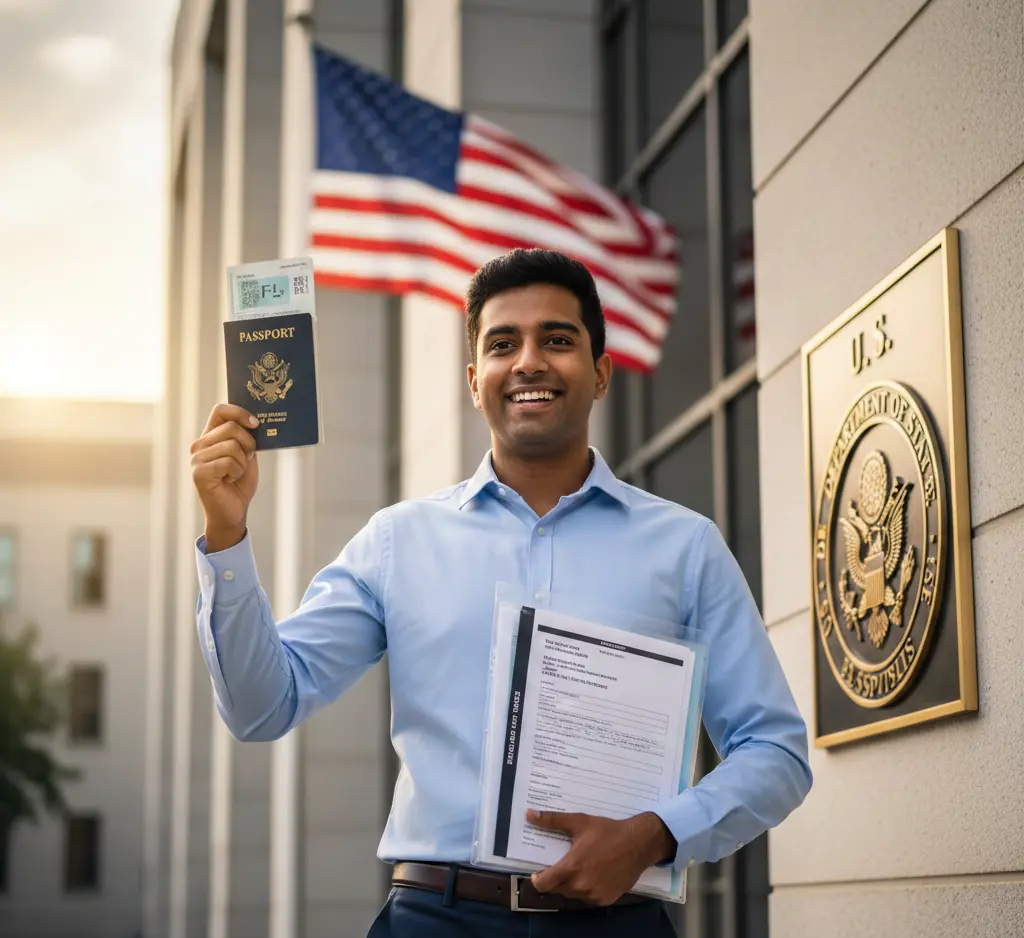
- Document Audit: Passport, signed I-20, DS-160, and SEVIS receipt in a clear folder.
Digital Check: Ensure your LinkedIn and social media profiles are professional.
Dress Rehearsal: Lay out your business-casual outfit (ironed and ready).
The Morning Of:
- No Electronics: Leave your phone and smartwatch at home or with a friend.
- Energy Check: Eat a light, healthy meal—waiting in line can take hours!
- The “Why” Pitch: Quickly practice your 30-second answer for “Why this university?”
Conclusion
The secret to the F-1 visa isn’t a secret at all—it’s preparedness. In 2026, the U.S. is looking for serious scholars who have a clear vision for how an American degree will empower their careers back in their home countries. Be precise, be honest, and most importantly, be yourself.
For the most current information regarding interview wait times and local consulate policies, always refer to the official U.S. Department of State visa resource.
FAQs on Achieving F-1 Visa Success 2026
No. You must have a physical or digital Form I-20 issued by a SEVP-certified institution before you can even book your visa appointment. The I-20 is your “ticket” to the interview.
n 2026, officers are very suspicious of “fund padding.” If you have a large recent deposit, be ready to explain it. Was it a matured fixed deposit? A property sale? A documented gift from a relative? Have the secondary paperwork (like a sale deed) ready to prove the money is real and yours to keep.
Yes. Never lie about this. The consular officer likely already knows the answer. If you lie, you risk a permanent ban for “willful misrepresentation.” Simply state who they are, where they live, and clarify that they are not the reason you are choosing to study in the U.S.
The officer isn’t looking for a poet; they are looking for a student. As long as you can clearly explain your study plans and finances, you’ll be fine. If you don’t understand a question, it’s perfectly okay to say, “I’m a little nervous, could you please repeat that?”
For 2026 appointments, aim to be there 15 to 30 minutes before your scheduled time. Arriving three hours early won’t get you in sooner, and it will only make you more tired and anxious.